Caller ID Spoofing: Why the Number Can Lie and What to Do
What spoofing and neighbour spoofing are, what to do when a call asks for information, and when spoofing is illegal. Based on FCC guidance.
What spoofing and neighbour spoofing are, what to do when a call asks for information, and when spoofing is illegal. Based on FCC guidance.
The call shows a local number, or the name of your bank, and the voice asks for information. Caller ID can be faked. This guide explains what spoofing is, what the FCC advises when you get such a call, and when spoofing is and is not illegal. The FCC page was last updated on 13 November 2024.
The FCC defines spoofing as a caller deliberately falsifying the information sent to your caller ID display to disguise their identity. Scammers often use "neighbour spoofing" so the call seems to come from a local number. Others copy the number of a company or government agency you may already trust. If you answer, they use scam scripts to try to get your money or personal information.
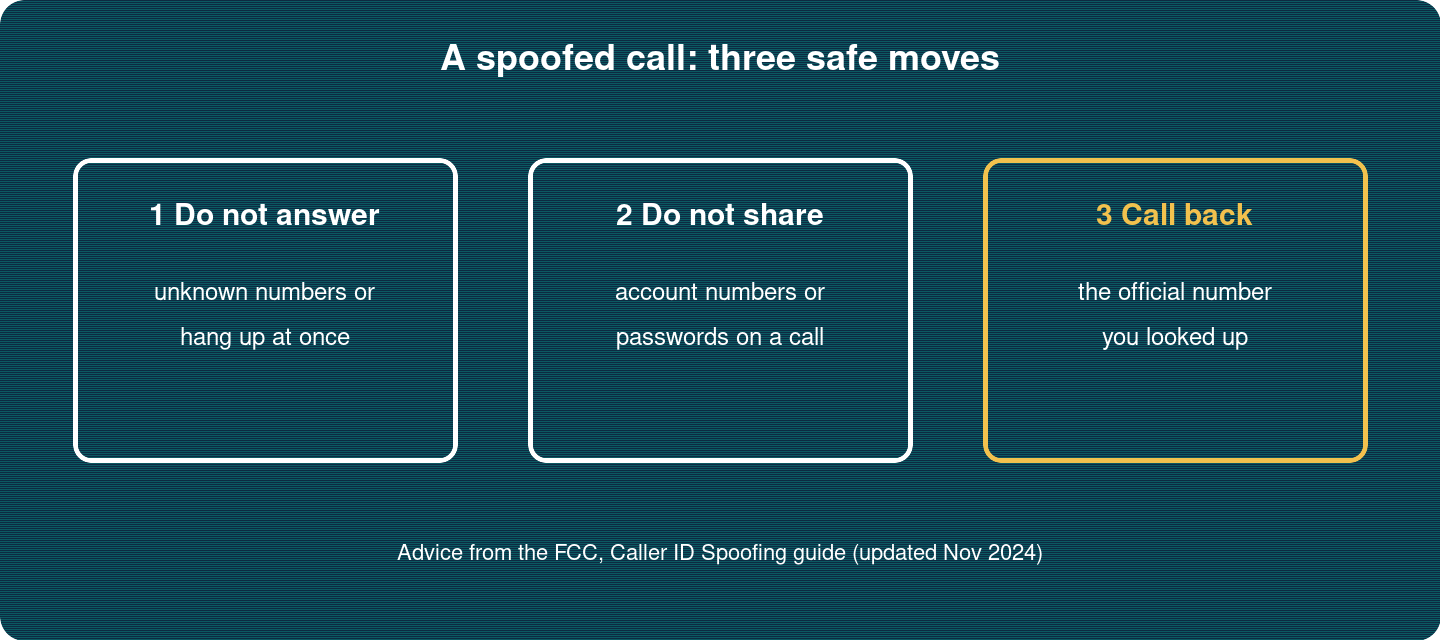
You may not be able to tell right away that a call is spoofed, so the FCC says to be extremely careful about any request for personal information.
If people say your number shows on their caller ID for calls you did not make, your number has probably been spoofed. The FCC suggests not answering unknown calls, but if you do, explain what is happening. You can also record a voicemail greeting saying your number is being spoofed. Scammers usually change numbers often, so within hours they are likely to stop using yours.
Under the Truth in Caller ID Act, FCC rules prohibit transmitting misleading or inaccurate caller ID information with intent to defraud, cause harm or wrongly obtain anything of value. The FCC says penalties can reach $10,000 per violation. But spoofing is not always illegal: a doctor calling from a personal mobile can display the office number, and a business can show its call-back number. You can also legally hide your own number so it shows as "unknown", which is not spoofing.
If a number is labelled "potential scam" or "spam", or is blocked, it may have been spoofed. Phone companies and apps detect likely fraud from call patterns and complaints. Labels are not proof either way, so use the same verification steps for any call that asks for money or information.
A call shows your bank's name and says there is suspicious activity. The caller wants to "verify" your card number. Hang up. Look up the number printed on your card or the bank's own website, and call that. If there really was a problem, that line can see it. Related: how to spot a phishing text uses the same idea for messages.